
May 2026
Eighteen million people in the U.S. reside within one mile of active oil and gas wells.
And since methane emissions from the oil and gas industry expose people nearby to other health-harming air pollutants, including volatile organic compounds (VOCs) that can increase asthma attacks and toxic air pollutants such as benzene that increase cancer risk, it’s no wonder a strong majority of the American public supports rules and regulations to limit methane waste. Even many of the biggest oil and gas companies say they support federal methane rules.
Why then are so many of these rules currently under siege?
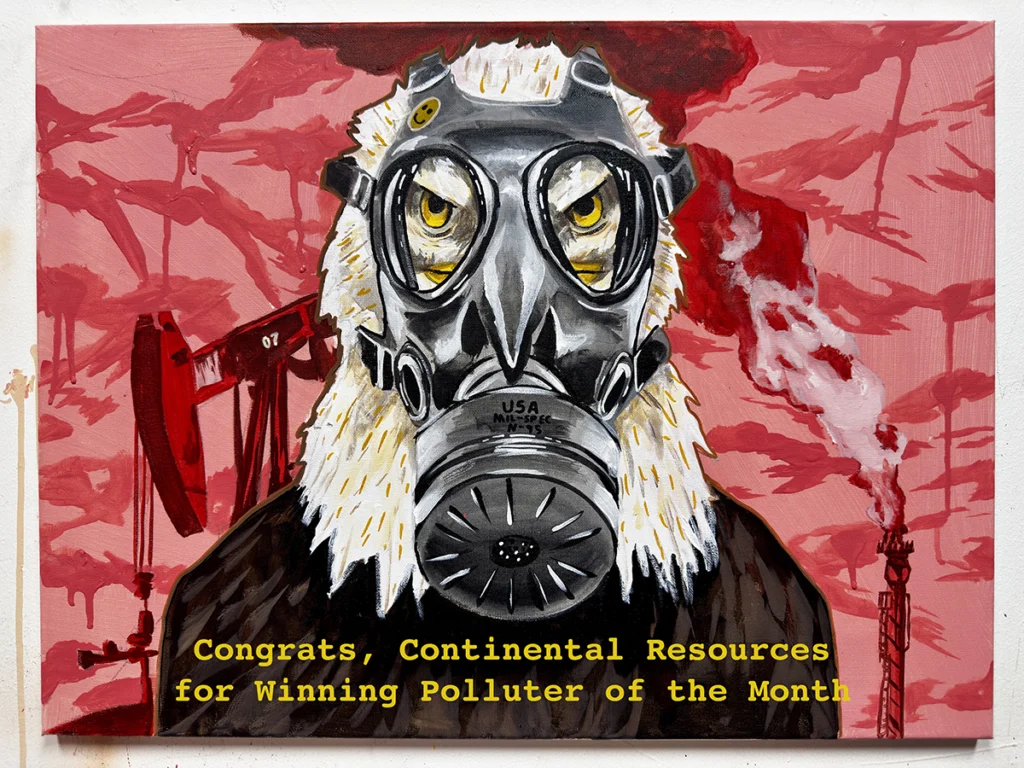
This is a story of power, access, and who stands to benefit from eliminating baseline emissions and public health protections, and perhaps no company is as close to the current administration’s energy policy than Continental Resources and its founder Harold Hamm.
Continental ranks among the oil and gas industry’s top methane polluters, and according to a 2024 report the company had the third highest emissions from associated gas venting and flaring of all U.S. producers. One analysis estimated that it would cost Continental only about $12 million to substantially reduce its methane emissions – for a company that reported a net income of $2 billion in 2025. Big Gas Polluters’ research also shows Continental is the largest U.S. oil and gas producer that has not established a methane reduction goal.
As the New York Times recently concluded, “Mr. Trump’s return to the White House is paying off handsomely for Continental”.
Stats
- Advancing negative positions on methane, climate, and public health. Continental says “we remain steadfast in our commitments to the health and safety of our workforce, to protection of the environment, and to being a strong corporate citizen everywhere we operate.” At the same time, it has championed the elimination of rules setting a baseline for emissions performance and public transparency:
- While many oil and gas groups have voiced support for federal methane regulations, Continental led the lawsuit attempting to overturn them.
- Continental received a victory as the Securities and Exchange Commission dismantled a rule requiring large companies disclose their emissions and any plans to reduce them. While Hamm officially retook Continental as privately held in 2022, the company continues to file regular reporting with the SEC as a requirement of its public-issued debt.
- For the last 15 years, EPA’s Greenhouse Gas Reporting Program created a standardized process for all oil and gas companies to tally up and publicly report their total annual emissions. When the current administration moved to dismantle the program last year, even Republican members of Congress and the bulk of the bulk of the fossil fuel industry objected. Dozens of groups representing the industry voiced their support for preserving it, including the American Petroleum Institute, the American Exploration and Production Council, LNG Allies, the Western Energy Alliance, the American Gas Association, and the U.S. Chamber of Commerce. Even big oil and gas companies submitted comments calling on the EPA to maintain the program “in its entirety” and because of “how difficult it will be to replicate the program’s benefits.” Among the only industry stakeholders urging EPA to dismantle the program: Continental Resources and Harold Hamm’s lobbying group, the Domestic Energy Producers Alliance.
- Pollution events large enough to be visible from space. Satellite data suggests Continental’s facilities were the source for several methane super-emitter events (which the Environmental Protection Agency describes as incidents releasing methane at a rate of at least 100 kilograms per hour). Since the start of 2025, at least five plumes documented in Carbon Mapper’s publicly accessible data portal appear next to its operations in North Dakota and Oklahoma. These included:
- One incident observed next to its SANDY – #1-29-32XH Well Pad;
- One incident recorded near its Triple Rimer 5 35 26XHW facility;
- One incident observed near its ALFSVAAG 1-31H facility; and
- An incident was documented next to its Simmental Federal 6-16H Well Pad on October 3, 2025 – and the next time the location was observed by the Tanager satellite, on March 6, 2026, another plume was documented emitting methane at an estimated rate of 747 kilograms per hour.
- Fines and penalties. Last year, a Clean Air Act emissions violation at one of the company’s facilities near Twin Valley, North Dakota resulted in a $75,000 penalty, and over the last two decades Continental has racked up over $900,000 in penalties for 14 separate air pollution or other environmental offenses, according to Violation Tracker data.